
💡 SSA Strategic Analysis: The Future of Federal Social Security
A comprehensive strategic analysis of the Social Security Administration (SSA), examining fiscal solvency, COLA impacts, and the economic future of the US retirement system.
Executive Summary
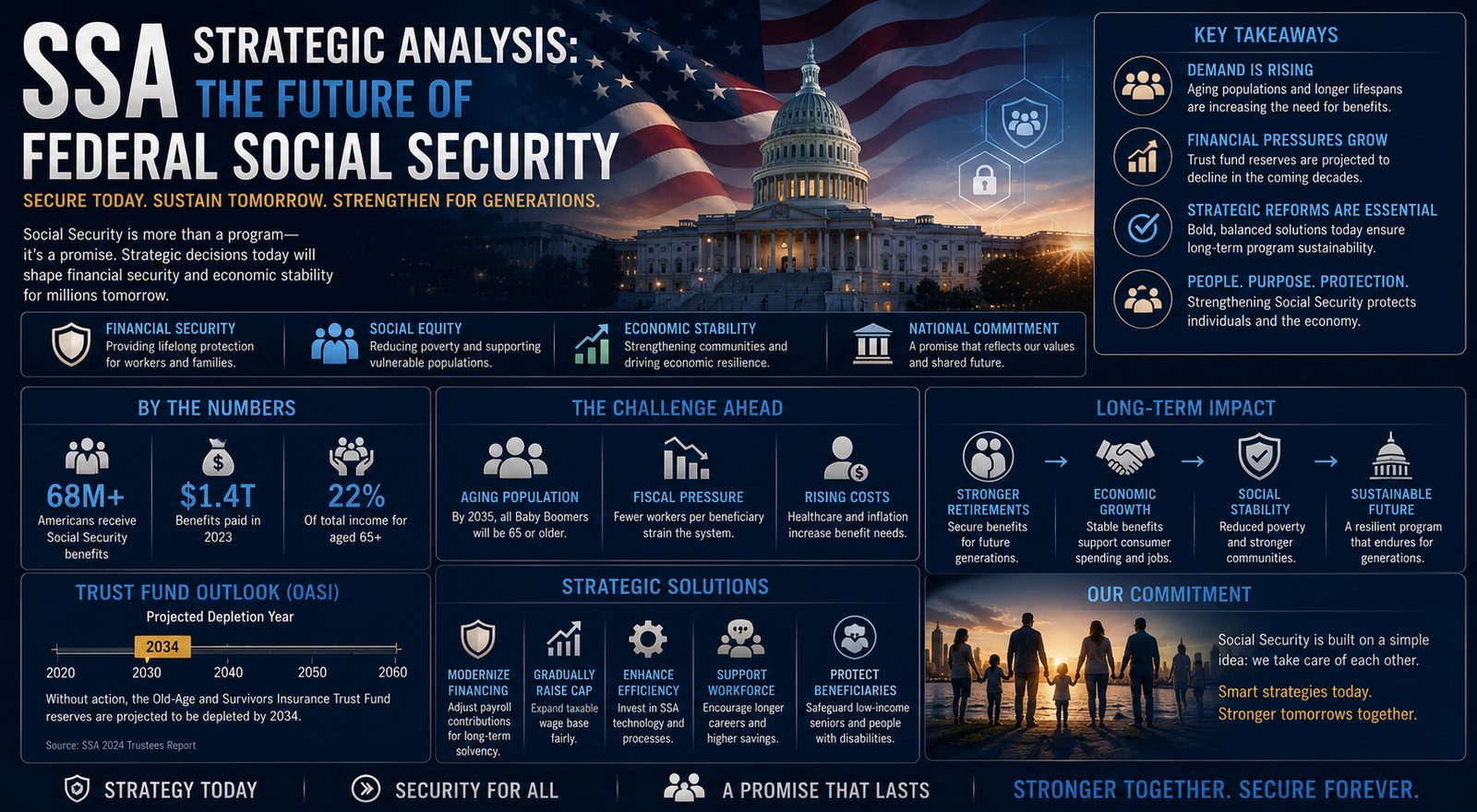
The Social Security Administration (SSA) stands as the largest social insurance program in the United States, managing a budget that exceeds 1.4 trillion dollars annually. This strategic analysis explores the critical challenges facing the SSA, primarily the projected depletion of the Old-Age and Survivors Insurance (OASI) Trust Fund by 2033. Key data highlights include the 2024 Cost-of-Living Adjustment (COLA) of 3.2 percent, the impact of 10,000 baby boomers reaching retirement age daily, and the shifting worker-to-beneficiary ratio. Our findings suggest that while the system is not headed for total collapse, significant legislative intervention is required to prevent a 20 to 25 percent benefit reduction within the next decade.
Introduction: The Pillars of American Social Insurance
The Social Security Administration is more than a government agency; it is a foundational element of the American economic architecture. Established in 1935, the SSA currently provides benefits to over 71 million people, including retirees, disabled individuals, and survivors. The scale of the SSA's operations is immense, accounting for approximately 5 percent of the United States' Gross Domestic Product (GDP). As we analyze the strategic landscape of federal benefits, it becomes clear that the SSA is at a crossroads. The intersection of demographic shifts, inflationary pressures, and fiscal sustainability defines the current era of social insurance management. Understanding the mechanics of the SSA is vital for anyone navigating the complexities of long-term financial planning.
The Deep Dive: Fiscal Solvency and Economic Realities
The primary concern for policy analysts and beneficiaries alike is the long-term solvency of the Social Security Trust Funds. According to the 2024 Social Security Trustees Report, the combined OASDI trust funds are projected to be able to pay 100 percent of scheduled benefits until 2035. After that point, if no legislative changes are made, the income from payroll taxes is expected to cover only 83 percent of scheduled benefits. This fiscal gap is driven by a demographic shift often referred to as the silver tsunami. In 1960, there were 5.1 workers for every one Social Security beneficiary. By 2023, that ratio dropped to 2.7, and it is projected to reach 2.3 by 2040.
The management of these funds involves complex financial instruments. While the Market Pricing and Valuation of private assets remains volatile, the SSA relies on special-issue Treasury securities. These securities are backed by the full faith and credit of the U.S. government, yet their ability to cover future obligations depends entirely on the government's ability to generate future surpluses or increase debt. The strategic management of these internal assets is a critical component of national fiscal health.
Inflationary Pressures and the COLA Mechanism
To maintain the purchasing power of benefits, the SSA utilizes the Cost-of-Living Adjustment (COLA). This adjustment is based on the Consumer Price Index for Urban Wage Earners and Clerical Workers (CPI-W). In 2023, beneficiaries saw a historic 8.7 percent increase, followed by a 3.2 percent increase in 2024. These adjustments are essential for seniors who face rising costs in healthcare and housing. The annual COLA is tied to the CPI-W, a metric often monitored by users of Forex Factory to gauge inflationary pressures and broader economic trends.
However, critics argue that the CPI-W does not accurately reflect the spending patterns of the elderly, who spend a disproportionate amount on medical services. There are ongoing strategic discussions regarding a shift to the CPI-E (Elderly), which could result in higher annual adjustments but would also accelerate the depletion of the trust funds. This creates a strategic paradox: protecting the immediate welfare of beneficiaries versus ensuring the long-term survival of the fund.
Operational Modernization and Administrative Challenges
Beyond the macroeconomics, the SSA faces significant operational hurdles. The agency's administrative budget has not kept pace with the growth in beneficiaries. Adjusted for inflation, the SSA's operating budget has decreased by roughly 10 percent since 2010, while the number of beneficiaries has grown by over 20 percent. This has led to record-high wait times for disability hearings and backlogs in processing initial claims. Strategic modernization is underway, with a focus on digital transformation. The SSA is investing in artificial intelligence and cloud computing to streamline the application process, yet the legacy systems remain a bottleneck for efficiency.

What This Means For You: Actionable Insights
For the average citizen, the strategic health of the SSA directly impacts retirement timing and savings targets. Here is a breakdown of how to interpret these findings:
- Retirement Timing: Delaying benefits until age 70 can increase your monthly check by approximately 8 percent for every year delayed beyond the full retirement age.
- Tax Planning: Depending on your total income, up to 85 percent of your Social Security benefits may be subject to federal income tax. Strategic withdrawal from 401k or IRA accounts is necessary to minimize this tax drag.
- Policy Awareness: Stay informed about legislative proposals such as the Social Security 2100 Act, which aims to increase the payroll tax cap. Currently, earnings above 168,600 dollars are not subject to the Social Security tax.
- Diversification: Given the potential for a 17 to 20 percent benefit cut in the 2030s, Social Security should be viewed as a floor for retirement income, not the entire ceiling. Supplemental savings are more critical than ever.
Expert Verdict / Future Outlook
The strategic outlook for the SSA is one of managed crisis. It is highly unlikely that Congress will allow the program to fail, as it would result in immediate poverty for millions of seniors. The most probable outcome involves a combination of three policy levers: gradually increasing the full retirement age to 68 or 69, raising the payroll tax cap to capture more income from high earners, and potentially adjusting the benefit formula for future high-income retirees. From a strategic perspective, the SSA remains a robust system, but its current trajectory is unsustainable without structural reform. The next five years will be a critical window for legislative action before the trust fund depletion becomes an immediate fiscal emergency.
FAQ: Authoritative Answers on SSA
1. Will Social Security run out of money by 2035?
No. Even if the trust funds are depleted, the system will still collect payroll taxes. These taxes are projected to cover approximately 83 percent of scheduled benefits. The program will not be penniless, but benefits will be reduced unless Congress acts.
2. How is the COLA calculated exactly?
The SSA compares the average CPI-W for the third quarter (July, August, September) of the current year to the average for the third quarter of the last year a COLA was determined. The percentage increase becomes the COLA for the following year.
3. At what age should I start claiming benefits?
Early retirement starts at 62, but results in a permanent reduction of up to 30 percent. Full retirement age is currently 67 for those born in 1960 or later. Waiting until 70 provides the maximum possible monthly benefit.
4. Are Social Security benefits taxable?
Yes, if your combined income (adjusted gross income + untaxed interest + half of your Social Security benefits) exceeds 25,000 dollars for individuals or 32,000 dollars for married couples filing jointly.
5. Can I work while receiving Social Security?
Yes, but if you are under the full retirement age, there is an earnings limit. For 2024, if you earn more than 22,320 dollars, the SSA will withhold 1 dollar for every 2 dollars earned above that limit.
Important Note: Financial Disclaimer: This content is for educational purposes only and does not constitute professional financial advice. Always consult with a certified financial planner before making investment decisions.
Conclusion
The Social Security Administration remains a vital but strained pillar of the American economy. While the threat of trust fund depletion is real, it serves as a catalyst for necessary reform rather than a signal of the program's end. A strategic approach to the SSA requires both individual preparation and collective policy advocacy to ensure the system's longevity for future generations.





Comments 0
Leave a Reply
Your email address will not be published. Required fields are marked *
Be the first to share your thoughts!