
💡 UIDAI: A Strategic Analysis of India's Digital Identity
A comprehensive authority guide on the UIDAI, exploring the strategic impact of Aadhaar on India's digital economy, security protocols, and financial inclusion.
Executive Summary
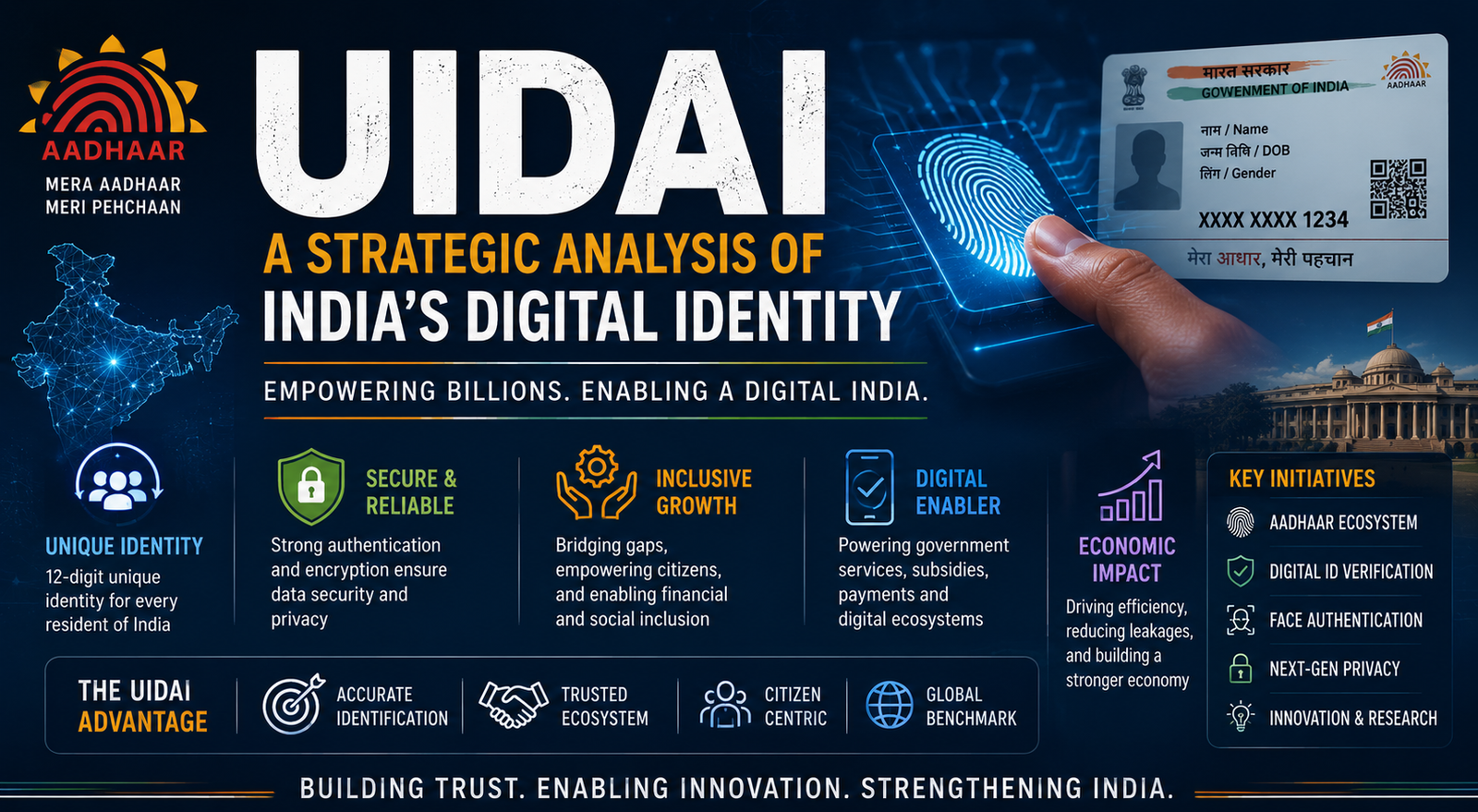
The Unique Identification Authority of India (UIDAI) represents one of the most significant technological shifts in modern governance. Established as a statutory authority under the Aadhaar Act 2016, it manages the world's largest biometric identity system. As of late 2023, UIDAI has issued over 1.38 billion Aadhaar numbers, covering nearly 99 percent of India's adult population. The strategic impact is measurable: the Government of India reports cumulative savings exceeding 2.73 lakh crore INR (approximately 33 billion USD) through Direct Benefit Transfer (DBT) by eliminating ghost beneficiaries. This analysis explores the technical architecture, legal frameworks, and the socio-economic implications of the Aadhaar ecosystem.
Introduction: The Foundation of Digital India
The inception of the UIDAI in 2009 marked a departure from traditional, paper-based identity systems toward a centralized, digital-first approach. At its core, the UIDAI was designed to provide a portable, verifiable identity to every Indian resident, particularly those in marginalized communities who lacked formal documentation. Unlike a passport or a driver's license, which serve specific functional purposes, Aadhaar was envisioned as a foundational identity. It does not confer citizenship but serves as a robust proof of residence and identity that can be authenticated online in real time.
The strategic importance of this infrastructure cannot be overstated. By providing a digital identity, the UIDAI enabled the creation of the India Stack, a set of open APIs that allow governments, businesses, and startups to utilize the Aadhaar infrastructure for presence-less, paperless, and cashless service delivery. This transition is as significant as the corporate shifts analyzed in the ITC Dividend 2026 Strategic Analysis, where data-driven precision dictates long-term value.
THE DEEP DIVE: Architecture, Security, and Governance
The UIDAI operates through a complex technological framework known as the Central Identities Data Repository (CIDR). This repository stores the demographic and biometric information of residents. The technical sophistication of the system involves 2048-bit encryption for data at rest and in transit, ensuring that personal identifiers remain secure from external breaches.
1. The Technical Infrastructure
The system utilizes three primary types of data: demographic (name, address, DOB), biometric (ten fingerprints, two iris scans, and a facial photograph), and metadata. When a resident authenticates their identity, the UIDAI does not share the actual biometric data with the requesting entity. Instead, it returns a simple Yes/No response. This privacy-by-design approach is critical in maintaining public trust.
- Authentication Types: OTP-based, Biometric (Fingerprint/Iris), and the recently introduced Face RD (Registered Device) service.
- Scalability: The system handles over 70 to 80 million authentications daily.
- Offline Verification: To reduce dependency on active internet connections, UIDAI introduced QR codes and offline XML files that contain masked data.
2. Economic Impact and Financial Inclusion
The integration of Aadhaar with the banking sector via the Aadhaar-linked Bridge Payment System (ABPS) has revolutionized financial inclusion. Before 2014, millions of Indians remained unbanked. The combination of Jan Dhan accounts, Mobile numbers, and Aadhaar (the JAM trinity) allowed for the rapid opening of over 500 million bank accounts. Similar to the economic scale seen in the Caitlin Clark Strategic Analysis of Economic Impact, the UIDAI has created a massive multiplier effect by bringing the informal economy into the formal fold.

3. Legal Framework and Privacy Concerns
The journey of the UIDAI has not been without legal scrutiny. In 2018, the Supreme Court of India delivered a landmark judgment upholding the constitutionality of Aadhaar but striking down Section 57, which allowed private entities to mandate Aadhaar for services. The court emphasized that Aadhaar is mandatory for welfare schemes and PAN linking but voluntary for bank accounts and telecom services. This legal clarity has strengthened the institutional leadership of the UIDAI, mirroring the high-stakes decision-making found in the Priya Dogra Strategic Analysis of Global Media Leadership.
WHAT THIS MEANS FOR YOU: Actionable Insights
For the average resident and professional, the UIDAI ecosystem offers several tools to manage and secure digital identity. Understanding these features is essential for maintaining personal data hygiene.
- Biometric Locking: Residents can lock their biometrics via the mAadhaar app or the UIDAI portal to prevent unauthorized authentication.
- Virtual ID (VID): Instead of sharing your actual 12-digit Aadhaar number, you can generate a 16-digit VID for temporary use, enhancing privacy.
- Aadhaar History: You can check your authentication history to see when and where your Aadhaar was used in the last six months.
- Document Update: UIDAI now recommends updating documents every 10 years to ensure the accuracy of the database.
Expert Verdict and Future Outlook
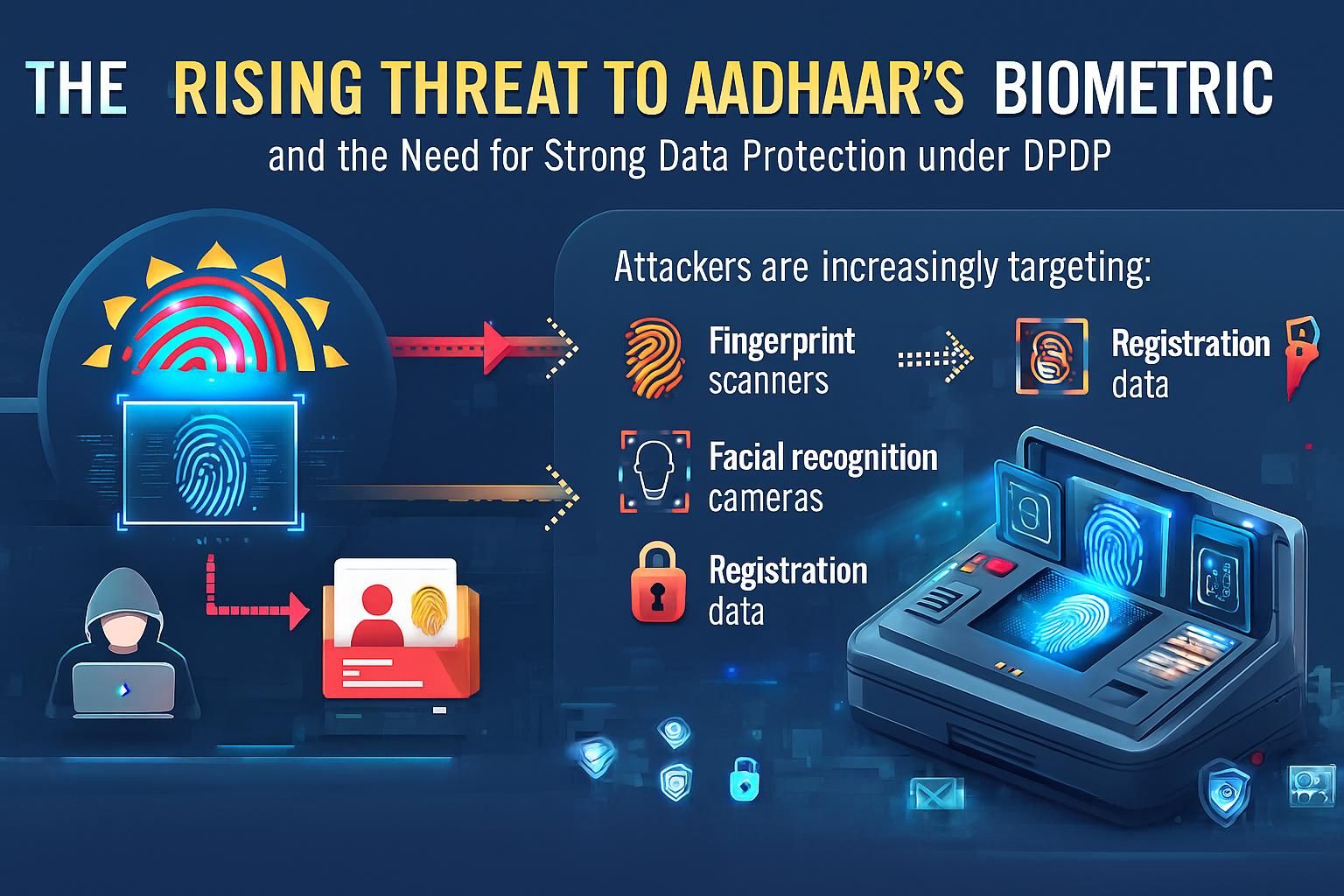
The UIDAI is currently transitioning toward Aadhaar 2.0. This next phase focuses on international expansion and technical upgrades. Several countries in Africa and Southeast Asia are looking at the UIDAI model to build their own national identity systems through MOSIP (Modular Open Source Identity Platform). Domestically, the focus is shifting toward Face Authentication, which uses artificial intelligence to verify identity without physical contact, a necessity highlighted during the global pandemic.
The future also involves deeper integration with the DigiLocker ecosystem, allowing for a truly paperless existence. As the organization moves forward, the balance between national security and individual privacy will remain the primary strategic challenge. However, the operational efficiency gained through this digital backbone is irreversible.
FAQ: Authoritative Answers
1. Is Aadhaar mandatory for opening a bank account?
According to the Supreme Court ruling, Aadhaar is not mandatory for opening a bank account. However, it remains one of the most widely accepted KYC documents due to its instant verification capabilities.
2. How can I protect my Aadhaar data from misuse?
The most effective way is to use the Biometric Lock feature available on the UIDAI website. Additionally, always use a Masked Aadhaar (which hides the first 8 digits) when providing copies for non-governmental purposes.
3. What is the Baal Aadhaar and when does it need to be updated?
Baal Aadhaar is issued to children under five years of age. It is blue in color. It must be updated with mandatory biometrics once the child reaches the age of 5 and again at the age of 15.
4. Can a non-resident Indian (NRI) get an Aadhaar?
Yes, NRIs with a valid Indian passport are eligible for Aadhaar on arrival in India, without the earlier mandatory waiting period of 182 days.
5. What should I do if my biometric authentication fails?
Authentication failure can occur due to worn-out fingerprints or technical glitches. In such cases, residents can use Iris authentication or OTP-based verification at enabled centers. Updating biometrics at an Aadhaar Seva Kendra is recommended if failures persist.
Important Note: Financial Disclaimer: This content is for educational purposes only and does not constitute professional financial advice. Always consult with a certified financial planner before making investment decisions.
Conclusion
The UIDAI has successfully established a digital infrastructure that serves as the bedrock of India's governance and economic strategy. By moving from a state of 'identity ignorance' to a state of 'digital certainty,' the authority has saved billions in taxpayer money and empowered over a billion people. As it evolves into its next iteration, the focus on security, privacy, and global interoperability will define its legacy as a world-class institutional model.





Comments 0
Leave a Reply
Your email address will not be published. Required fields are marked *
Be the first to share your thoughts!